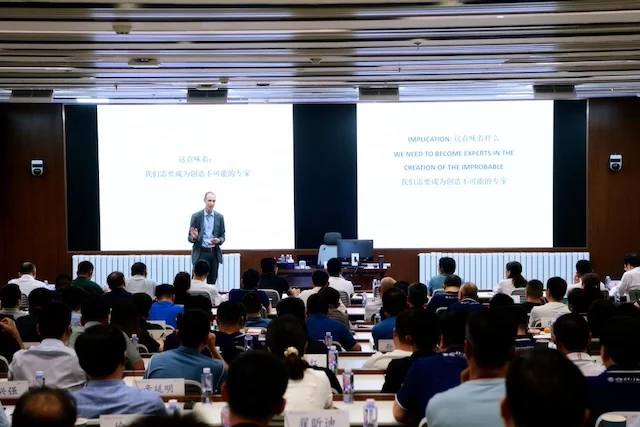
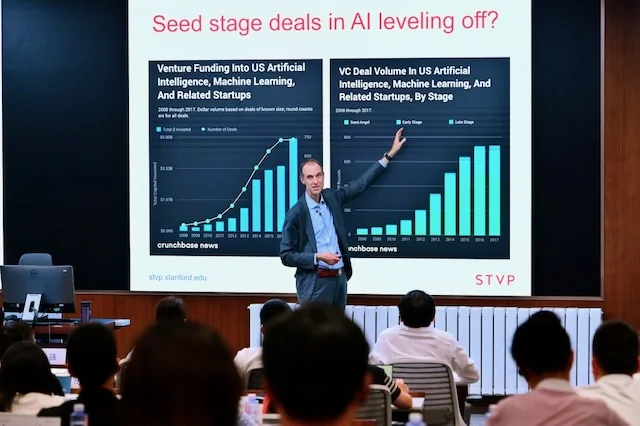
Engineering pedagogy at scale — three Stanford courses, the ITRI–Stanford ATV program, Stanford BOSP Shenzhen, and the open-sourced MOOC that reached 200,000 students. Syllabi and teaching cases below are open-sourced. Use, adapt, and build on them.
Current courses
Technology Entrepreneurship: Stanford E145
Stanford Engineering · originally created by Tom Byers · taught by Chuck since 2009 (with Rebeca Hwang and Pedram Mokrian in the summers)
The flagship Stanford technology entrepreneurship course. Project-based introduction to the discipline of building technology ventures — opportunity identification, customer development, team formation, and the institutional context around startups.
Recently re-anchored on the NAE Grand Challenges for Engineering: the Fall 2026 syllabus directs student teams to identify, scope, and prototype ventures that address one of the 14 NAE Grand Challenges — making engineering's most consequential open problems (solar energy, clean water, secure cyberspace, personalized learning, urban infrastructure, brain reverse-engineering, and the rest) the explicit subject matter of the course's project track. This aligns the course with the NAE's flagship undergraduate engineering-education framework, and gives student teams a clearer civic and technical frame for what their ventures should be trying to do.
The online version, recorded for free between 2013 and 2018, reached more than 200,000 students worldwide and seeded the company that later became NovoEd, acquired by Devonshire Investors / Fidelity.
Stanford MS&E · graduate course · co-taught with Vimbayi Kajese
MS&E's graduate-level course on the international, cross-institutional dimensions of engineering entrepreneurship. How different countries' institutional environments — capital markets, IP regimes, labor mobility, government industrial policy, regulatory regimes — shape who can build a high-growth technology venture, and what those founders actually build. The course gives engineering and MS coterminal students who are heading into globally distributed founder teams a clearer model of the institutional terrain they will be working across.
Together with E145 (undergraduate technology entrepreneurship) and MS&E 379 (PhD-level causal inference for entrepreneurship research), MS&E 272 forms a three-level engineering-entrepreneurship education program at Stanford MS&E — entry-level founder fluency, graduate-level institutional and cross-border depth, and doctoral-level methodological training.
Recently revised for the agentic AI era: the course now spends substantial time on what AI agents change about cross-border venture formation — talent geography, customer development at unfamiliar distances, regulatory exposure across jurisdictions, and the new shape of entrepreneurial cognition when the founder is working alongside agents that don't share their institutional intuitions. The revision puts MS&E 272 among the earliest graduate engineering-entrepreneurship courses to treat agentic AI as a first-class object of study rather than as commentary.
"The class fundamentally changed how I think about entrepreneurship and strategy — especially the frameworks around how to use AI to research / draft and when it falls short. The regional deep dives were also a great overview of what different startup ecosystems look like around the world."
Causal Inference for Entrepreneurship Research: MS&E 379
Stanford MS&E · PhD-level
Doctoral seminar on quasi-experimental methods for empirical entrepreneurship and strategy research — difference-in-differences, regression discontinuity, instrumental variables, synthetic control, and the growing toolkit of LLM-based methods for policy and regulatory corpora.
Entrepreneurship Doctoral Research Seminar: MS&E 372
Stanford MS&E · PhD-level · Autumn
Classic and current research on entrepreneurship, focused on how entrepreneurship may exacerbate or alleviate inequalities across race/ethnicity, gender, and class — and how institutional environments shape who engages in entrepreneurship and how successful they become. Readings drawn from economics, sociology, and strategy/management. Limited enrollment, restricted to PhD students.
International & executive programs
ITRI–Stanford Platform: Advancing Technology Ventures Program
Academic Director · 2013–present
Twelve-week program developed in partnership with Taiwan's Industrial Technology Research Institute (ITRI), the Department of Industrial Technology (DOIT), and the Ministry of Economic Affairs (MOEA). Mentors deep-tech startup teams on commercial development and global market entry.
Stanford BOSP Shenzhen Global Seminar
Faculty Director · August 2026
Stanford Bing Overseas Studies Program seminar based at InnoX Academy in Shenzhen, examining China's innovation ecosystem from inside one of its most active corridors. The first BOSP short-term program to use Shenzhen as a destination. Fifteen Stanford undergraduates worked in six teams on hardware projects ranging from baby-stroller temperature sensors to spray-tan applicators to balance and agility data with performance feedback, and the three weeks covered working with Shenzhen suppliers and factories, the history of the city's institutional reforms, and how to build hardware prototypes and startups.
KFUPM Founders Track: Dhahran Techno Valley × King Fahd University of Petroleum & Minerals
Academic Director
Eight-month deep-technology founder development program developed in partnership with King Fahd University of Petroleum & Minerals (KFUPM) and Dhahran Techno Valley. Bridges KFUPM student talent to Silicon Valley and global innovation ecosystems. Program site ↗.
Aramco Lab7: Advancing Technology Ventures
Academic Director · Stanford CGOE (formerly SCPD) executive program · partner: Saudi Aramco Lab7
Multi-session corporate-innovation program for Saudi Aramco's Lab7 program, run through the Stanford Center for Global & Online Education (CGOE). Cohort-based structure with three in-person workshops alternating between Stanford and KSA. The October 2025 – January 2026 cohort focused on commercial development pathways for Aramco-incubated deep-tech ventures.
The Chinese University of Hong Kong: Faculty in Residence
Aug–Dec 2023 · via Stanford BOSP
Semester in residence at CUHK through Stanford's Bing Overseas Studies Program.
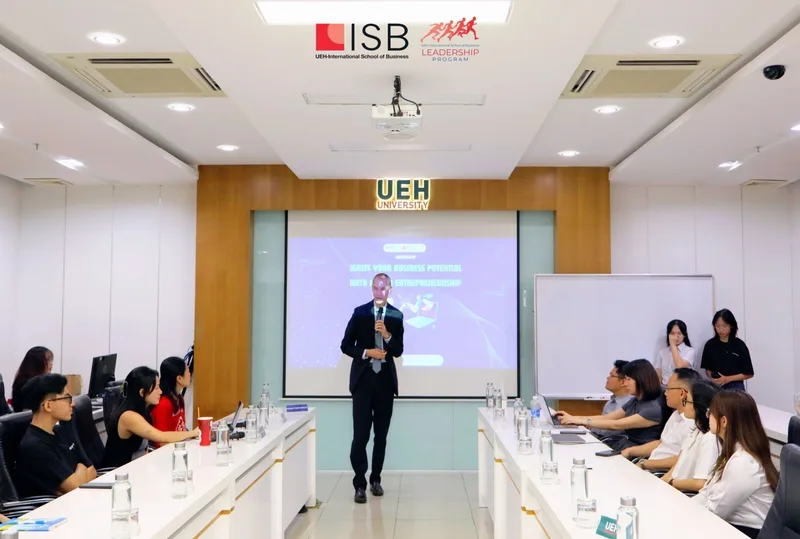
UEH International School of Business: Entrepreneurship Workshop, Ho Chi Minh City
Guest workshop · UEH–ISB Leadership Program · Ho Chi Minh City, Vietnam · December 2024
A guest workshop for the University of Economics Ho Chi Minh City (UEH) International School of Business Leadership Program — "Ignite Your Business Potential with Entrepreneurship" — working with Vietnamese students on opportunity identification and building early-stage ventures.
Mentorship & student programs
BASES: Stanford's largest entrepreneurship student organization
Faculty Advisor
Faculty advisor to BASES (Business Association of Stanford Engineering Students), which runs Stanford's flagship undergraduate entrepreneurship competitions, mentorship programs, and the student-run E-Bootcamp.
PhD advising
I advise PhD students in MS&E whose work intersects entrepreneurship, institutional design, industrial policy, AI's effects on innovation, or the global political economy of technology. For prospective applicants →
Many course assistants have taught alongside me in E145, MS&E 272, MS&E 372, MS&E 379, and the international programs since 2009 — their work is part of what makes large-enrollment engineering entrepreneurship pedagogy possible at this scale.
Practitioner-in-Residence & Course Assistant — BOSP Shenzhen Global Seminar (August 2026). Health-tech founder; previously led digital health at Tencent.
Syllabi, teaching cases, and talks on pedagogy — open-sourced for any instructor who wants to use or adapt them. Attribution appreciated; no permission required.
Short teaching cases written for E145 and MS&E 272. Each case foregrounds a specific institutional or strategic decision rather than a comprehensive company history — designed for 20–30 minutes of in-class discussion.
For educational use only. These cases are prepared as a basis for class discussion — not as endorsements, sources of primary data, or illustrations of effective or ineffective management.
Labayh
Saudi teletherapy platform navigating cultural stigma around mental health and the operational challenges of scaling a two-sided digital health marketplace through COVID-19. Foregrounds founder decisions on trust-building, professional credentialing, marketing innovation, and customer adoption in a market where the institutional context is unusually constrained. Co-authored with Michael Lepech (Stanford Engineering) and colleagues at King Fahd University of Petroleum & Minerals.
Venezuelan BNPL fintech that reached US$300M monthly volume on roughly US$2M raised. Foregrounds how constraint-driven institutional design — a 1,500-page regulatory submission, a merchant-financed credit architecture, and a creative reuse of the Caracas Stock Exchange — can produce a structurally better business than the standard Silicon Valley playbook would have built.
Stanford founders Himanshu Gupta (MBA ’17) and Maximilian Evans (MBA ’17) built ClimateAI to make climate forecasts decision-ready for businesses and governments. Foregrounds design thinking and lean experimentation in a nascent market, with explicit teaching applications in market sizing, business-model choice (SaaS vs. consulting), and mission-versus-margin tension.
Teaching Entrepreneurship in the AI Era. STVP event at Google Huddle, hosted by Emily Ma. On how the agentic-AI moment changes what we teach in entrepreneurship courses — what stays, what gets replaced, and what becomes newly important.View the slide deck (PDF, 390 KB) ↗
The Future of Entrepreneurship Education at STVP. MS&E 25th Anniversary, May 2025. Opening vision and closing reflections, bookending a fireside chat between Steve Blank and Riitta Katila. Watch on Talks & Media →
Teaching honors
Stanford Teagle Fellow in Liberal Education (2022)
Richard Schulze Inaugural Distinguished Professorship Award (2015)
Talks about teaching, learning at scale, and the STVP pedagogical model are on the Talks & Media page. Curated course readings are on the Reading list.