A selected set of talks, interviews, and lectures, organized by what they're about, not when they happened.
Intro · short overview
Upcoming
Invited seminars and convenings on the calendar.
Session Organizer: INFORMS Annual Meeting, San Francisco
"Empirical Research on Engineering Entrepreneurship, Policy, and Capital Allocation"
November 1–4, 2026. Organizing an invited session co-sponsored by MSOM Technology, Innovation, and Entrepreneurship and TIMES (Technology, Innovation Management, and Entrepreneurship). The session brings together empirical work on how U.S. export controls, the CHIPS and Science Act, the Inflation Reduction Act, and the evolving U.S.–China technological decoupling have reshaped where engineering ventures form, who funds them, and which technologies receive capital. Papers draw on administrative micro-data, longitudinal alumni surveys, and quasi-experimental designs across the semiconductor sector, advanced manufacturing, clean energy and climate technology, and underrepresented founder populations.
Invited Seminar: Ross School of Business, University of Michigan
A throughline across recent policy-relevant talks: how subsidies, export controls, and federal R&D allocations shape who builds what, and where.
Invited Seminar: Guanghua School of Management, Peking University
Beijing, September 15, 2026. Host: Jiamin Zhang. Presented Subsidizing the Supply Side: Industrial Policy, Firm Entry, and Innovation in China's Battery Manufacturing Sector (with Guankai Zhai).
SCECR 2026, Tokyo: Industrial Policy and Venture Capital Allocation
Two papers presented at the Symposium on Statistical Challenges in Electronic Commerce Research, Tokyo, Japan, June 21–24, 2026: Industrial Policy Reshapes Venture Capital Allocation and Growth Trajectories in Climate Technologies, and When External Shocks Attract Capital: Export Controls and Venture Capital Allocation in China.
Subsidizing the Supply Side: Industrial Policy, Firm Entry, and Innovation in China's Battery Manufacturing Sector
Paper presentation at the 14th Annual Strategy Symposium on Emerging Markets, Rice Business, May 14, 2026 (with Guankai Zhai). Evidence that supply-side subsidies without capability screening attract more entrants, but the marginal firms are short-lived, non-innovative, and exit at elevated rates even in thriving battery clusters.
National Academies: GUIPRR Workshop
Government-University-Industry-Philanthropy Research Roundtable, Washington, DC, March 31–April 1, 2026. Panelist on the macroeconomics of research investment (moderated by Maryann Feldman, with Laura Appenzeller, Brian Darmody, and Susan Helper). Argued that university commercialization structures were built for a linear publish–patent–license pipeline that no longer matches venture timelines; that indirect-cost cuts, declining international enrollment, and export controls are compressing the founder talent supply; that spinoff readiness depends on the founder more than the technology; and that the U.S. is running the largest industrial-policy experiment in a generation without an evaluation framework to know whether the bets are working.
Joint Economic Committee staff briefing on industrial policy, export controls, and U.S.–China technology competition. Washington, DC, March 13, 2026.
UNLV Troesh Research Conference
Conference on national competitiveness and regional innovation ecosystems. Las Vegas, January 29–30, 2026.
Nanyang Technological University, Singapore
Invited seminar, January 2026, on industrial policy and venture capital allocation under cross-border policy shocks.
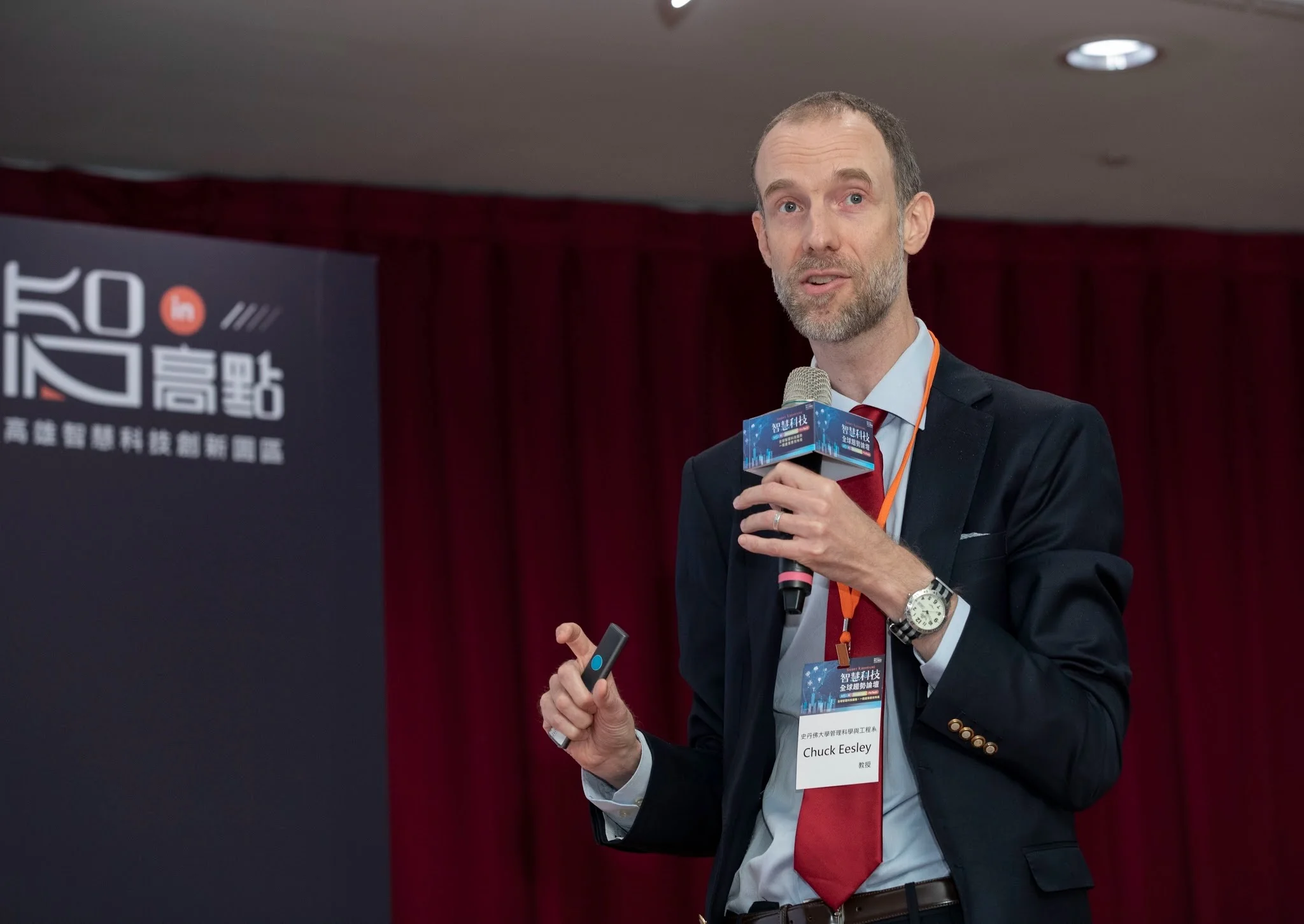
Smart Technology Global Trends Forum: Kaohsiung Smart Technology Innovation Park (KSTIP)
Invited speaker at the Smart Technology Global Trends Forum (智慧科技全球趨勢論壇) at the Kaohsiung Smart Technology Innovation Park, sponsored by Taiwan's Industrial Technology Research Institute (ITRI). Part of the long-running ITRI–Stanford partnership on advancing technology ventures and Taiwan's deep-tech innovation ecosystem.
Kaohsiung Smart Technology Innovation Park · sponsored by ITRI
Research findings
How institutional environments shape who becomes an entrepreneur and which ventures scale.
Keio Management Society Seminar, Tokyo: AI Strategy and Entrepreneurship
Keio University Mita Campus, Tokyo, June 22, 2026 (hybrid). Hosted by the Keio Management Society. On how AI, institutional design, education systems, and policy environments shape entrepreneurial strategy, venture formation, and innovation outcomes.
Four Paradigms for AI-Enabled Social Science Research
Lightning talk at the FDS Workshop on AI for Social Science Research Methods, Yale University, May 22, 2026 (with Guankai Zhai; Chuck presenting). On how generative AI is reshaping social-science research design, from automated coding and synthetic experimentation to LLM-based content analysis of regulatory corpora.
Stanford Innovation Study: The Economic Impact of Stanford Entrepreneurship
Findings from the alumni survey with William F. Miller on the economic impact of Stanford-founded companies, the foundational study showing that companies founded by Stanford alumni generate trillions of dollars in revenue and millions of jobs globally. Stanford eCorner, 2012.
The MIT alumni-impact study with Edward B. Roberts (Chuck's doctoral advisor), and the methodological forerunner of the Stanford Innovation Study above. Found that companies founded by MIT alumni would, if grouped as an independent nation, generate roughly $2 trillion in annual worldwide sales, the 11th largest economy in the world at the time. Kauffman Foundation report, 2009.
Are You Experienced or Are You Talented? When Does Innate Talent versus Experience Explain Entrepreneurial Performance?
Using the MIT alumni dataset, this paper separates the part of entrepreneurial performance attributable to innate talent (selection of who becomes a founder) from the part attributable to accumulated experience (learning across ventures). The answer turns out to depend on context: experience matters more in environments where the playbook is established; talent shows up more sharply in novel, uncertain settings where there isn't one to copy. Strategic Entrepreneurship Journal, 2012 (with Edward B. Roberts).
Awarded the Strategic Entrepreneurship Journal 2026 Best Paper Prize. The prize is presented at the Awards Recognition Ceremony of the 46th SMS Annual Conference in Berlin on 17 October 2026, also honoring the contributions of the late Edward B. Roberts to the work.
The Economic Impact of Entrepreneurial Alumni: A Case Study of the University of Virginia
The third in the alumni-impact trilogy (after MIT 2009 and Stanford 2012), applying the same methodology to UVA. Survey of more than 135,000 UVA alumni (22,757 valid responses) found that the school's entrepreneurial graduates have launched roughly 65,000 companies, employing 2.3 million people worldwide and generating an estimated $1.6 trillion in annual global revenues, with disproportionate impact on the Virginia state economy. UVA Darden Batten Institute, 2014 (with Michael Lenox, Andrew King, and Asif Mehedi).
Activist tactics and how firms get targeted for social change, when secondary stakeholder pressure tactics succeed in shifting firm behavior, and when they don't. Strategic Management Journal, 2016 (with Katherine DeCelles and Michael Lenox).
How founding conditions shape whether ventures survive or thrive through environmental change. Strategic Entrepreneurship Journal, 2023 (with Motley and Koo).
Survey of 2,067 MIT alumni-founded ventures showing that all-technical founding teams have a 12.8% greater likelihood of favorable exit in cooperative business environments, challenging the conventional wisdom that diverse business skills always matter most. Strategic Management Journal, 2014 (with David Hsu and Edward B. Roberts).
Do University Entrepreneurship Programs Promote Entrepreneurship?
Survey of 27,783 Stanford alumni asking what the Stanford Center for Entrepreneurial Studies (CES) at the GSB and the Stanford Technology Ventures Program (STVP) at the Engineering School actually did to their entrepreneurship rates. The sobering finding: CES participation had a negative-to-zero effect on entrepreneurship rates and STVP participation had no effect, but CES participants saw lower startup failure and higher long-term firm revenue. Strategic Management Journal, 2021 (with Yong Suk Lee).
The Persistence of Entrepreneurship and Innovative Immigrants
Stanford alumni survey examining how entrepreneurship rates differ by ethnicity and nationality, drawing on the 2011 Stanford Innovation Survey of more than 140,000 alumni. Asian American alumni are more entrepreneurial than white American alumni, but non-American Asian alumni are substantially less so, and parental entrepreneurship turns out to be a strong predictor regardless of group, with intergenerational persistence highest among non-American Asians. Policy implications for both U.S. immigration and how Asian countries pursue entrepreneurship promotion. Research Policy, 2018 (with Yong Suk Lee).
How Entrepreneurs Leverage Institutional Intermediaries in Emerging Economies
How founders in emerging economies use incubators, accelerators, and business associations to acquire public resources they couldn't otherwise reach. Strategic Management Journal, 2017 (with Armanios, Li, and Eisenhardt).
Entrepreneurial Strategies During Institutional Changes: Evidence from China's Economic Transition
What China's regional economic transition tells us about which entrepreneurial strategies pay off when institutions shift. Strategic Entrepreneurship Journal, 2022 (with You (Willow) Wu and Delin Yang).
Market catalysts, incubators, science parks, junior stock exchanges, are designed to stimulate venture creation. Analysis of 19,000 firms in Japan shows they can produce unintended negative consequences: more competition and information asymmetry, ultimately fewer quality IPOs and less economic growth. Stanford eCorner conversation with Bob Eberhart on their Strategic Management Journal paper, 2018.
For Startups, Adaptability and Mentor Network Diversity Can Be Pivotal
Evidence from a randomized experiment on the NovoEd MOOC platform, what kinds of mentor connections, and what kinds of adaptability, actually predict whether early-stage ventures succeed. MIS Quarterly, 2020 (with Lynn Wu).
Learning-by-Advising? Startup Learning as an Advice-Giver in Accelerators
Randomized field experiment embedded in an online accelerator program in Thailand, a five-year collaboration with AIS (Advanced Info Service) and KBank (Kasikornbank), testing whether providing structured peer evaluations benefits the advice-giver, not just the receiver. With 166 early-stage startups across multiple cohorts (2021–2023), treatment teams gained an average +0.217 points on independent pitch-quality scores and +0.108 points on idea usefulness; no significant effect on idea novelty. Working paper, December 2024 (with Zhuoxuan Li and Jungyun Han).
Ideas from the classroom, E145, MS&E 272, ETL, and international programs.
Technology Entrepreneurship, Stanford E145
Course preview for the flagship Stanford technology entrepreneurship course Chuck has taught since 2009.
The 27-lecture video collection on the Stanford YouTube channel was recorded for the online version of the course, which ran free for five years and reached more than 200,000 students worldwide, seeding many companies in its wake. The platform built to deliver it spun out as NovoEd, later acquired by Devonshire Investors / Fidelity.
Raising Investment in Emerging Economies: E145 lecture segment
Lecture segment from Stanford E145 / NovoEd on what's actually different about raising capital in emerging markets, the missing institutions investors in mature ecosystems take for granted (collateral systems, credit history, exit routes, follow-on capital networks), what credible substitutes look like when those institutions are thin, and what the empirical research on Chinese, Indian, and African venture financing has surfaced about which interventions actually move outcomes.
Recorded as part of the E145 MOOC offered free via NovoEd for five-plus years, this segment was also part of the inspiration for MS&E 272, Entrepreneurship Without Borders, the graduate course Chuck later created (co-taught with Vimbayi Kajese) to give engineering students a fuller treatment of cross-border venture formation that a single MOOC lecture couldn't cover.
MS&E 25th Anniversary, May 2025. Opening vision for STVP and closing reflections, bookending a fireside chat between Steve Blank and Riitta Katila.
0:00 , Opening vision (Chuck Eesley)
9:59 , Fireside: Steve Blank with Riitta Katila
45:06, Closing on the future of STVP and MS&E (Chuck Eesley)
Angel Investing 102: Thriving in a Disruptive World
Stanford Angels & Entrepreneurs United, December 2021. A data-driven session for Stanford alumni angel investors, traits and behaviors of successful angels, historical analysis of past performance and returns, and what the institutional environment around technology entrepreneurship actually rewards.
Long-form discussions on research, career, and the institutional view of entrepreneurship.
The Innovator Coffee: AI and the Compressed Validation Cycle
The Innovator Coffee podcast (hosts Wickey Wang and Tom Kong), 2026. A wide-ranging conversation on how AI is reshaping entrepreneurship: why AI has compressed the startup validation cycle from roughly six months to a single week — and the danger of running fast in the wrong direction; why “AI safety” means far more than “don't build killer robots”; and trust as an underrated competitive moat in the AI era. Chuck also walks through three findings founders tend to resist — that persistence can hurt long-term outcomes, that the solo-unicorn founder is a dangerous myth (team composition matters enormously), and that replacing real customer conversations with AI conversations is one of the most common and costly mistakes — drawing on a large-scale A/B study across tens of thousands of founders. Closes with five-to-ten-year AI predictions.
JoJo Garden: Stanford Professor Charles Eesley
JoJo Garden, February 27, 2026. Ninety-minute long-form conversation with award-winning television host JoJo Zou on entrepreneurship, AI in education, AI in social impact, and the Zhou & Eesley Family Foundation's work to level the playing field for underserved communities globally. Chinese-subtitled. JoJo Garden was credentialed as self-TV media in APEC and at the White House; the program features Nobel laureates and leaders across fields.
On Stanford, Silicon Valley, and the Innovation Virtuous Cycle
郝会DAILY interview series, July 2025. Conversation with Hao Yang (郝杨), Chairman of the Shenyang Fund Association (沈阳市基金业协会), on how Stanford and Silicon Valley grew up together, the talent magnet effect, the Google / PageRank licensing story, Lean Launchpad and Stanford's entrepreneurship pedagogy, the cultural tolerance for failure, the venture capital model and the pay-it-forward ethos, and the current openness questions around AI and immigration.
"Stanford's Startup Prof"
Angel Invest Boston with Sal Daher, Episode 82. On the MIT / Ed Roberts lineage, NovoEd, and what makes ecosystems work.
Mezcal Negronis and the Economics of Misinformation
Creative Distillation podcast (Episode 78), CU Boulder Leeds School of Business, March 2025. Conversation with Rob Hahn (founder of Avanti) on the algorithmic financing of online misinformation, AI-era venture diligence, and what the institutional environment around founders actually shapes.
Keough School of Global Affairs (Washington, D.C.), March 11, 2025. Chuck participated in a panel of AI developers and adopters at this Notre Dame workshop convening government, civil society, and private-sector experts on AI's impact on workers and on the policy interventions that could help workers adapt. Insights to be synthesized in a forthcoming white paper.
Innovation Movement / Declare Innovation, January 2013. Short advocacy statement on the immigrant-entrepreneur findings from the Stanford Innovation Survey, about 44% of Stanford alumni entrepreneurs are immigrants, with about 15% staying in the Bay Area and contributing to the regional economy. Pre-publication framing for the institutional argument that later became the Research Policy 2018 paper with Yong Suk Lee on the persistence of entrepreneurship and innovative immigrants.
Entrepreneurship and Racial Justice: ETL panel
Stanford eCorner / STVP Entrepreneurial Thought Leaders, November 4, 2020 (Season 16, Episode 6 · 50 minutes). Panel moderated with Jessica Norwood (founder of RUNWAY, closing the racial wealth gap through pre-seed capital for Black-owned companies) and Rodney Sampson (CEO of Opportunity Hub, a multi-campus entrepreneurship center for under-tapped communities). On how to address racial disparities in startup funding and what it takes to build a more equitable entrepreneurial community. The shorter A Lens of Racial Equity micro-episode immediately below was excerpted from this conversation.